
Table of Contents
Introduction
Time management helps students balance school, coaching, and self-study without feeling overwhelmed. Students preparing for competitive exams like NEET and nursing entrance tests often struggle with one major problem — managing time between school, coaching classes, and self-study. Many feel overwhelmed, tired, and confused about what to study and when.
The truth is, success in exams is not just about studying hard. It is about studying smart and managing your time properly. This is where balancing school coaching and self study becomes very important.
According to research, students who follow a structured study plan are 30% more likely to complete their syllabus on time compared to those who study randomly. Time management also reduces stress and improves focus, which directly impacts exam performance.
In today’s competitive environment, students attend school for 6–7 hours, coaching classes for 2–4 hours, and still need time for revision and practice. Without a proper plan, this becomes exhausting.
This guide will help you create a practical and realistic blueprint to manage everything effectively without burnout.
1. Understanding the Challenge of Balancing School, Coaching & Self Study
Balancing school coaching and self study is not easy because each of these requires time, attention, and energy.
School provides the foundation of subjects, coaching focuses on competitive exam preparation, and self-study helps you revise and strengthen concepts.
A typical student’s day looks like this:
- School: 6–7 hours
- Coaching: 2–3 hours
- Travel & breaks: 2 hours
This leaves very limited time for self-study.
A study on student productivity shows that most students waste 2–3 hours daily on distractions like mobile phones and social media. Reducing this wasted time can significantly improve study efficiency. Good time management improves focus and ensures that all subjects get proper attention every day.
The biggest challenges students face include:
- Lack of proper planning
- Feeling tired after long school hours
- Not knowing what to study
- Ignoring revision
- Overloading the schedule
To solve this, you need a clear blueprint.
Why Self-Study is Critical
Even if you attend the best coaching classes, self-study is where real learning happens. Experts say that at least 50% of preparation should come from self-study.
Self-study helps you:
- Understand concepts deeply
- Practice questions
- Revise regularly
- Improve weak areas
Without self-study, coaching alone is not enough.
2. Creating a Smart Daily Schedule That Works
The key to balancing school coaching and self study is to create a realistic daily schedule that you can follow consistently.
Step 1: Prioritize Tasks
Not all tasks are equally important. Focus on:
- Concept learning
- Practice questions
- Revision
Avoid spending too much time on passive activities like just reading notes.
Step 2: Use Time Blocking
Divide your day into time blocks. For example:
- Morning (Before School – 1 hour): Quick revision
- Afternoon (After School – 2 hours): Rest + light study
- Evening (After Coaching – 2–3 hours): Practice + revision
Time blocking helps you stay focused and avoid confusion.
Step 3: Follow the 3-2-1 Rule
- 3 hours concept learning
- 2 hours practice
- 1 hour revision
This structure ensures balanced preparation.
Step 4: Keep It Realistic
Do not create a schedule like: “I will study 10 hours daily.”
Instead, aim for 4–6 effective hours of self-study, which is enough if done properly.
Studies show that focused study sessions are more effective than long, distracted hours.
With effective time management, students can reduce stress and complete their syllabus on time.
Step 5: Add Breaks
Your brain cannot focus continuously. Use:
- 50 minutes study + 10 minutes break
This improves productivity and prevents burnout.
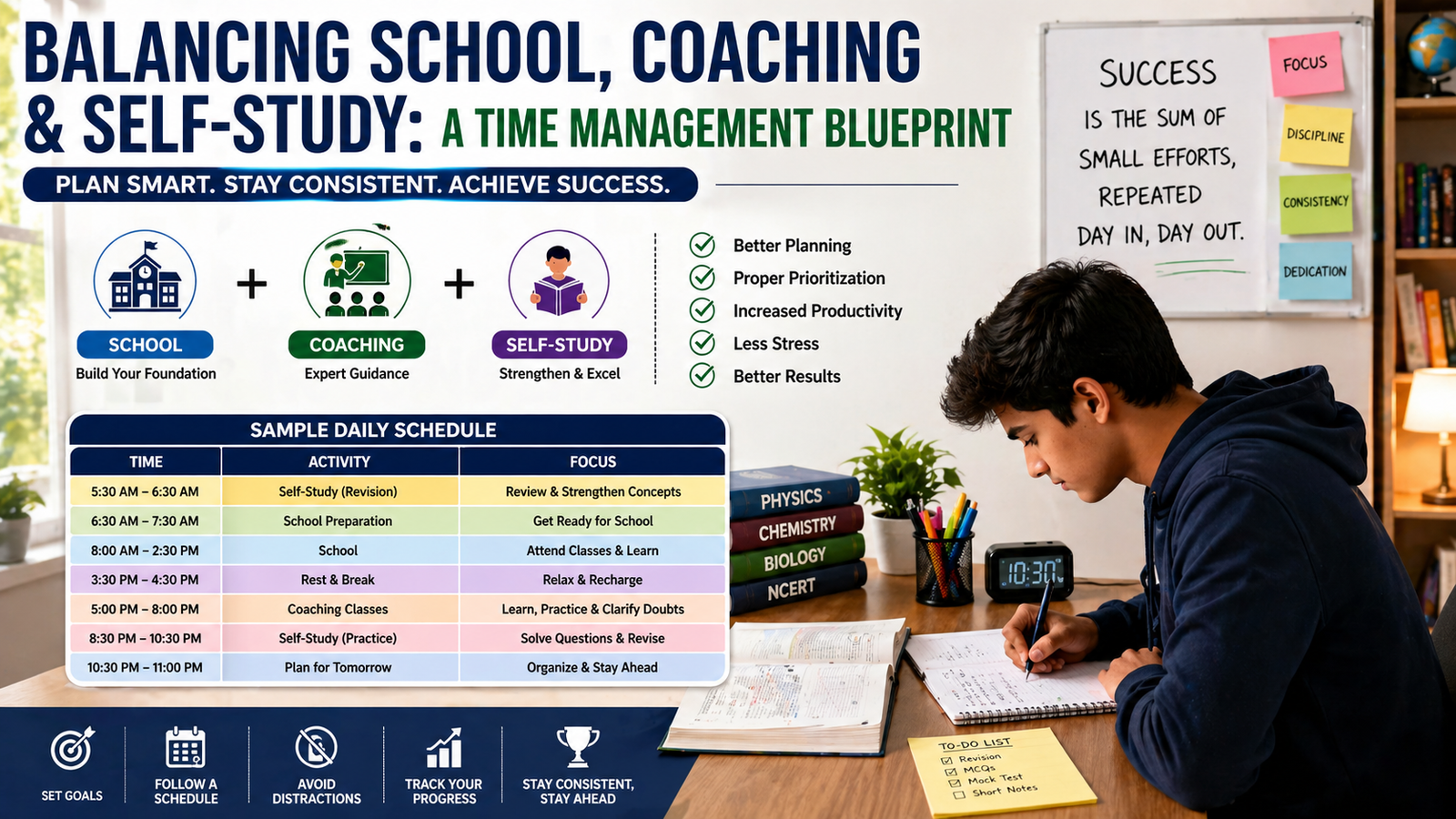
Sample Daily Routine
- 6:00 – 7:00 AM → Revision
- 7:30 – 2:00 PM → School
- 3:00 – 5:00 PM → Rest + Light Study
- 5:00 – 8:00 PM → Coaching
- 9:00 – 11:00 PM → Practice + Revision
This is a balanced approach for most students.
3. Practical Strategies to Stay Consistent and Avoid Burnout
Consistency is the most important part of balancing school coaching and self study. Even the best plan will fail if you cannot follow it daily.
1. Focus on Quality, Not Quantity
Studying for 3 focused hours is better than 8 distracted hours.
Research shows that attention span drops after long study sessions, so shorter focused sessions are more effective.
Time management allows you to plan your study sessions smartly instead of studying randomly.
2. Avoid Multitasking
Do not study multiple subjects at the same time. Focus on one subject per session.
Multitasking reduces efficiency and increases errors.
3. Use Active Learning Techniques
Instead of just reading:
- Solve MCQs
- Practice previous year questions
- Use flashcards
Active learning improves retention by up to 50% compared to passive reading.
4. Track Your Progress
At the end of each day, ask yourself:
- What did I complete?
- What is pending?
Tracking helps you stay accountable.
5. Take Care of Your Health
Many students ignore health, which affects performance.
Important habits:
- Sleep 7–8 hours daily
- Eat healthy food
- Stay hydrated
Studies show that proper sleep improves memory and concentration significantly.
6. Stay Flexible
If you miss a study session, do not panic. Adjust your schedule instead of giving up.
7. Avoid Common Mistakes
- Overloading your schedule
- Skipping revision
- Ignoring weak subjects
- Comparing with others
Your plan should be based on your needs, not others.
Conclusion
Balancing school coaching and self study may seem difficult, but with the right strategy, it becomes manageable.
The key is to create a realistic schedule, stay consistent, and focus on quality study.
Strong time management skills can increase productivity and improve overall exam performance.
Remember:
- Self-study is as important as coaching
- Time management is the key to success
- Consistency beats motivation
If you follow this blueprint, you can reduce stress, stay organized, and improve your chances of success in competitive exams.
Success is not about doing everything perfectly. It is about doing the right things consistently.
